
 EN
EN

Verify Production Capacity and Reliability of the Colored Tissue Paper Manufacturer
Evaluating MOQ, lead time, and scalable output for consistent bulk fulfillment
When sourcing a colored tissue paper manufacturer, align minimum order quantities (MOQs) with your inventory budget and demand forecast. Reputable partners offer tiered MOQs—often starting around 10,000 units for standard bulk orders—without compromising quality or flexibility. Lead time is equally critical: top-tier suppliers guarantee fulfillment in under 30 days for palletized shipments, supported by automated production lines that reduce delays by 65% compared to manual operations, per Packaging Insights 2023. Scalability matters most during peak seasons; verify the manufacturer can reliably absorb 200% demand surges while maintaining consistent GSM, color fidelity, and structural integrity across all batches.
Confirming facility capability through audits, throughput data, and equipment modernity
Schedule virtual or in-person facility tours to assess ISO-certified production environments firsthand. Focus verification on three pillars:
- Throughput metrics: Request verified hourly output reports demonstrating sustained capacity of 5,000+ sheets per hour across multiple dye runs
- Equipment modernity: Confirm computer-controlled dye systems calibrated to maintain Pantone variance within ΔE < 2—critical for brand-critical color accuracy
- Operational resilience: Ensure backup power, redundant dye vats, and real-time IoT monitoring are in place to prevent downtime during 24/7 production cycles
Manufacturers publishing live production dashboards or sharing granular throughput data signal strong supply chain transparency—and benchmark at 40% lower defect rates than industry averages.
Ensure Quality Consistency and Regulatory Compliance
Key specs: GSM, fiber composition, ply count, and embossing precision for commercial use
Commercial-grade colored tissue paper must meet exacting functional standards. Grammage (GSM), typically 16–40 depending on application, governs thickness, drape, and tear resistance. Virgin fiber delivers superior tensile strength and brightness for premium gift or cosmetic packaging; recycled content offers sustainability benefits but requires rigorous testing for consistency in absorption and printability. Ply count (single vs. multi-layer) directly influences durability and cushioning performance, while precision embossing enhances both aesthetic appeal and functional liquid retention—especially vital in food service or high-end retail applications. A trusted manufacturer provides standardized test reports (e.g., TAPPI or ISO 536) for each batch, validating these parameters against agreed specifications.
Mandatory certifications (FSC, ISO 9001, REACH) and batch color consistency protocols
Third-party certifications are non-negotiable indicators of operational rigor. FSC certification confirms responsibly sourced pulp; ISO 9001 validates documented, auditable quality management systems; and REACH compliance ensures dyes and additives meet stringent EU chemical safety thresholds. For color consistency—where even minor deviations erode brand trust—leading facilities deploy spectrophotometer-controlled dye vats, standardized D65 lighting for shade evaluation, and strict Delta E ≤2 tolerances across all production runs. This level of control prevents costly rework or rejection of bulk shipments due to mismatched Pantone references.
Evaluate Customization and OEM Capabilities
Pantone color matching, size/pattern flexibility, and compatibility with printing or lamination
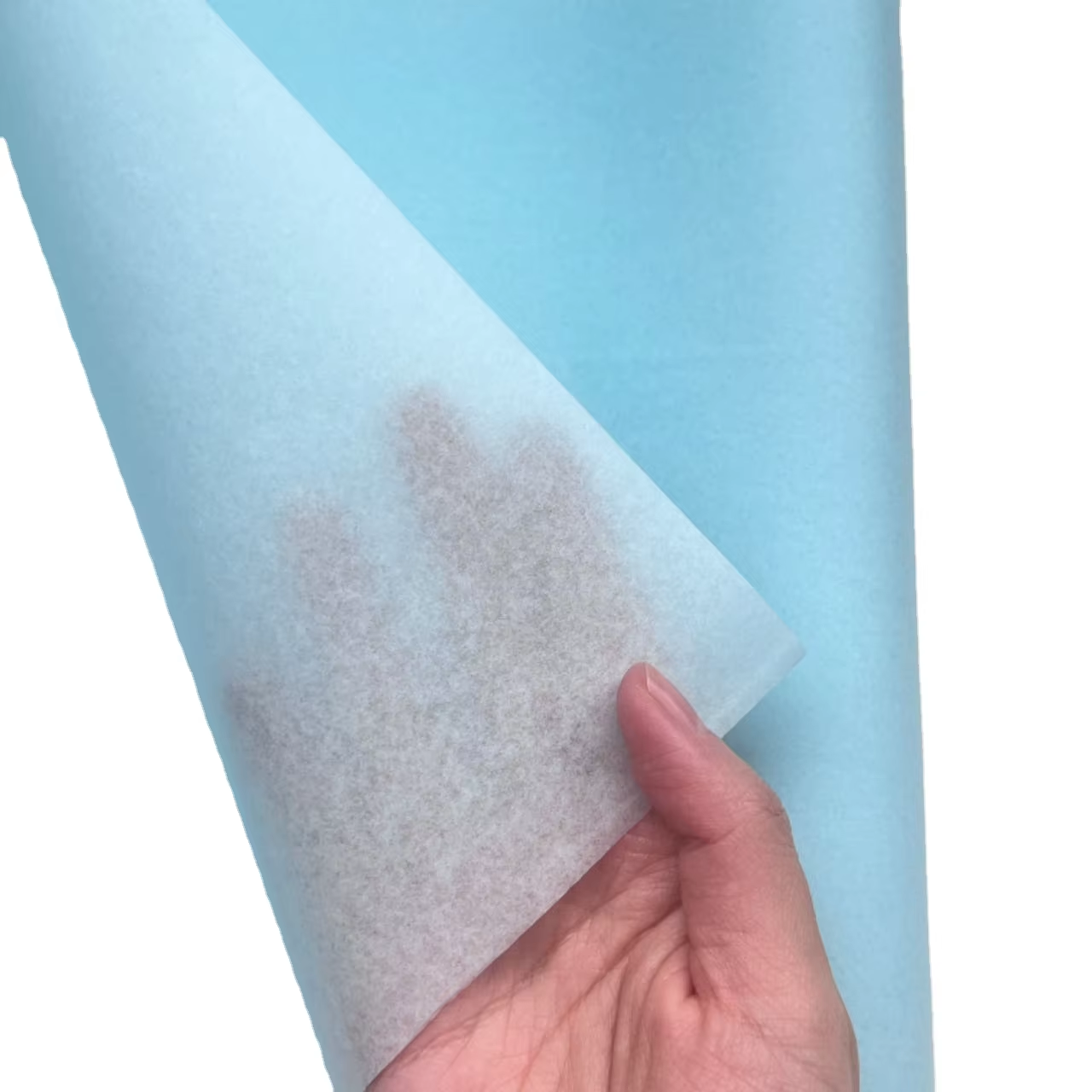
Pantone Matching System (PMS) validation is foundational—not just for initial approval, but for repeatable, cross-batch accuracy. Industry surveys show 98% of corporate buyers rank PMS consistency as their top customization priority. Beyond color, assess true dimensional agility: Can the manufacturer produce non-standard sizes (e.g., 22” × 28” or custom die-cut formats) without minimum surcharges? Confirm availability of embossed patterns—including fine-line, geometric, or branded motifs—and validate substrate compatibility with digital printing, foil stamping, or lamination. Crucially, verify that moisture-resistant lamination does not degrade softness, opacity, or folding performance—key attributes for luxury packaging applications.
Private-label support: logo imprinting, branded packaging, and end-to-end OEM workflow
Robust OEM capability extends far beyond logo placement. Look for partners offering full-cycle private-label execution: collaborative design consultation, physical prototyping (including material and print proofs), production-scale trials, integrated QC checkpoints, and co-branded shipping cartons with shelf-ready structural design. Minimum imprint thresholds should be reasonable—ideally under 5,000 units—without sacrificing registration accuracy or ink adhesion. Most importantly, confirm seamless workflow integration: no handoffs between separate vendors, no gaps in documentation, and shared accountability from concept to delivery. This end-to-end ownership minimizes risk and ensures brand integrity remains uncompromised at every stage.
Assess Logistics Transparency and Long-Term Partnership Reliability
Logistics transparency is the cornerstone of supply chain resilience—especially for time-sensitive, volume-driven tissue paper orders. A strategic partner provides real-time shipment tracking, proactive delay notifications, and quarterly performance reporting covering on-time-in-full (OTIF) rates, order accuracy, and average resolution time for quality exceptions. With 68% of shippers now demanding enhanced visibility (2024 Logistics Transparency Index), manufacturers offering secure dashboard access or API-integrated data feeds demonstrate serious commitment to partnership. Consistent, candid communication—about capacity constraints, raw material volatility, or process improvements—builds mutual trust and enables smarter joint planning. That reliability transforms a vendor relationship into a growth-enabling alliance, ensuring your colored tissue paper arrives consistently, on spec, and on schedule—every time.