
 EN

How tissue paper for garment packing prevents marks on finished clothing
A finished shirt, dress, knit, or tailored piece can leave the packing table looking clean and arrive with clear fold impressions, surface rub, or transferred color. Tissue paper for garment packing is useful because it creates a light buffer layer where fabric would otherwise meet fabric, hardware, or a carton surface. It is not a substitute for sound folding, dry storage, or a suitable outer pack. It is one part of a controlled packing routine.
From a packaging-paper technical advisor’s perspective, the starting point is the use case: lining, interleaving, wrapping, or void control. Tissue paper for garment packing should be evaluated against the garment’s fabric, finish, fold pattern, handling speed, and likely transit conditions. That framing turns a vague request for “protective tissue” into a practical material-and-workflow decision.
Why finished clothing picks up marks in a pack
Marks usually result from contact plus pressure. A hard fold can compress a crisp fabric finish; a zipper pull, button, tag, or printed area can rub against an adjacent panel; and stacked items can hold that contact in place during storage or shipping. Tissue paper for garment packing adds a low-bulk interface that helps separate those contact points.
That is the appearance side. The next question is how the garment reaches the packing table. If garments are folded while warm from pressing, handled with dusty gloves, or placed in a damp area, tissue alone cannot solve the process issue. Tissue paper for garment packing works more consistently when the garment is clean, dry, fully cooled where relevant, and placed into an appropriately sized pack without excessive compression.
How interleaving changes the contact pattern
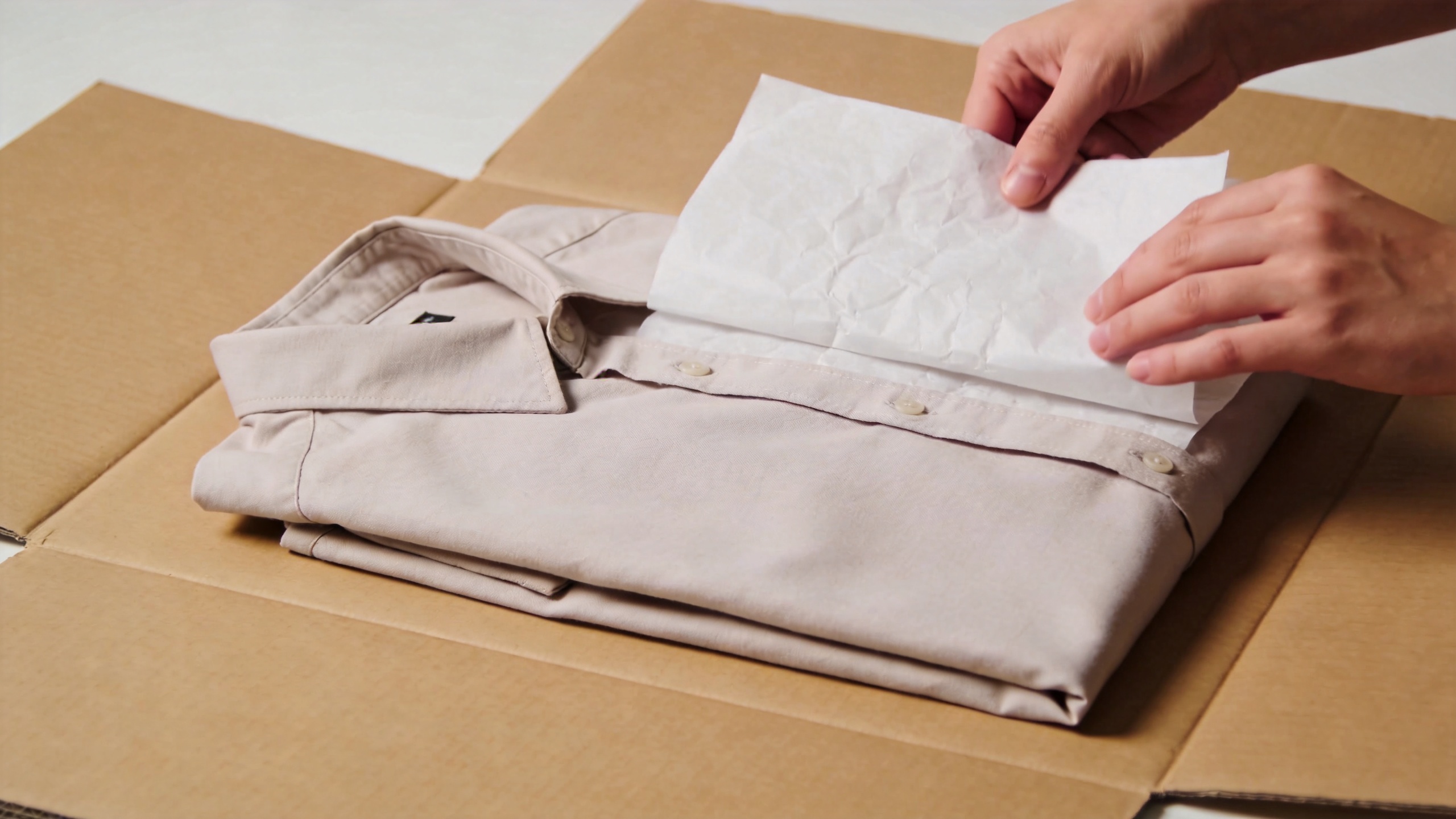
For many garments, tissue paper for garment packing is placed between fold layers rather than merely wrapped around the outside. The sheet helps distribute direct fabric-on-fabric contact and gives delicate sections a smoother buffer across the fold. In a blouse, that may mean a sheet across the front panel before sleeves are folded in. In a jacket, it may mean separating lapels, trims, and a folded body panel.
Cloth wrapping paper can be useful as a general search term, but the actual choice should follow the packing job. A tissue that is too small leaves exposed contact zones. A sheet that is too bulky can create its own pressure ridge. Tissue paper for garment packing should therefore be sampled in the same sheet size, fold method, and carton configuration used in daily fulfillment.
Four material checks before setting a packing specification
1. Surface feel and lint behavior
Run a small trial with the finished garment. Tissue paper for garment packing should be assessed for whether its surface catches on embellishments, sheds visible fibers, or changes the look of dark, smooth, or high-sheen fabrics. A visual check under the lighting used for final inspection is more useful than a generic material claim.
2. Color and moisture transfer risk
Colored tissue can support presentation, yet color transfer needs its own sample check. Tissue paper for garment packing that will touch light-colored textiles should be tested under the expected humidity, contact time, and handling friction. Plain or light tissue may be easier to assess visually, but a buyer should still confirm the relevant material specification with the supplier.
3. Sheet size and fold coverage
A sheet should cover the zones it is meant to separate. Tissue paper for garment packing can be cut or specified to match garment dimensions, but the aim is not maximum coverage at any cost. The aim is reliable coverage of fold lines, trims, prints, and areas likely to rub during packing.
4. Handling at the packing station
Consider how operators take, place, and fold each sheet. Tissue paper for garment packing that is awkward to separate, tears too easily in normal handling, or slows the workflow may lead to inconsistent use. A short trial across several operators often reveals issues that a desk review misses.
A practical fold-and-interleave routine
- Inspect the garment and confirm that it is dry, clean, and ready for packing.
- Lay tissue paper for garment packing on the key panel or fold area before bringing layers together.
- Use an additional sheet around trims, prints, or hardware where contact could leave a visible impression.
- Place the folded garment into a pack that does not force it into a tighter shape.
- Open a sample after a realistic hold period and inspect both the garment and tissue for rub, lint, moisture, or color movement.
This routine does not promise a mark-free outcome in every supply chain. Instead, tissue paper for garment packing gives the team a repeatable way to reduce direct-contact variables and observe whether the selected material suits the actual garment.
Where tissue helps most—and where it has limits
Tissue paper for garment packing is often most relevant for smooth woven fabrics, pressed garments, dark or light colorways that show surface changes readily, pieces with trims, and retail-ready folding. It can also support a more orderly unboxing presentation. For long-term textile storage or unusually sensitive finishes, request the appropriate material documentation and confirm the intended storage conditions rather than assuming one tissue grade is suitable for every application.
It is also important to separate fold impressions from broader transit damage. Tissue paper for garment packing may reduce rubbing within a garment fold, but it cannot address crushing caused by an overloaded outer carton or moisture introduced elsewhere in the delivery chain. Those conditions need packaging and logistics controls of their own.
Questions to ask before ordering
- Which fabric, finish, print, trim, and fold zones will the tissue contact?
- Will tissue paper for garment packing be used as an interleaf, an outer wrap, or both?
- What sheet size and count fit the packing sequence without creating excess bulk?
- Does the intended color require a transfer test under expected humidity and pressure?
- What supplier documentation or sample result is needed before the specification is released?
Rather than choosing a paper by color alone, clarify how each garment is folded, handled, and packed. Tissue paper for garment packing can be a measured part of that workflow: it separates surfaces, supports a more controlled fold, and creates a clear sample-and-inspection point before a packing method is scaled.