
 EN

Why Wrapping Tissue Paper for Clothes Avoids Ink Transfer on Fabrics
When a customer opens a garment order, the first contact is often the paper around the fold. That makes wrapping tissue paper for clothes more than a presentation detail. Used thoughtfully, it creates a clean separation layer between garments, printed surfaces, labels, and the inside of the mailer or box. It cannot promise that every ink-transfer problem will disappear, but it can reduce avoidable direct contact while a brand checks the real source of risk.
From a packaging-paper technical advisor’s perspective, the useful question is not simply “which tissue is appropriate?” It is whether the tissue, garment finish, packing sequence, and storage conditions work together. That is the difference between a neat unboxing experience and a pack-out process that leaves marks, scuffs, or uncertainty.
Start by separating two different transfer risks
People often say “ink transfer” when they mean several different things. Ink or dye can move from a freshly printed garment, a dark garment with poor colorfastness, a printed hangtag, a sticker, an outer carton, or the tissue itself. Wrapping tissue paper for clothes helps most directly when it prevents two surfaces from rubbing together. It is a buffer, not a diagnosis of every printing or dye problem.
That distinction matters. Textile colorfastness testing commonly examines whether color moves from a colored textile to another surface under rubbing. In a real packing line, friction, pressure, moisture, warmth, and time can all change the outcome. A garment that is dry and stable after normal handling may need a different response from a newly printed item or a shipment likely to face humid conditions.
At first this may look like a paper decision; more accurately, it is a garment-and-workflow decision. Before selecting wrapping tissue paper for clothes, identify which surface could release color and which surface needs protection.
How tissue creates a practical separation layer
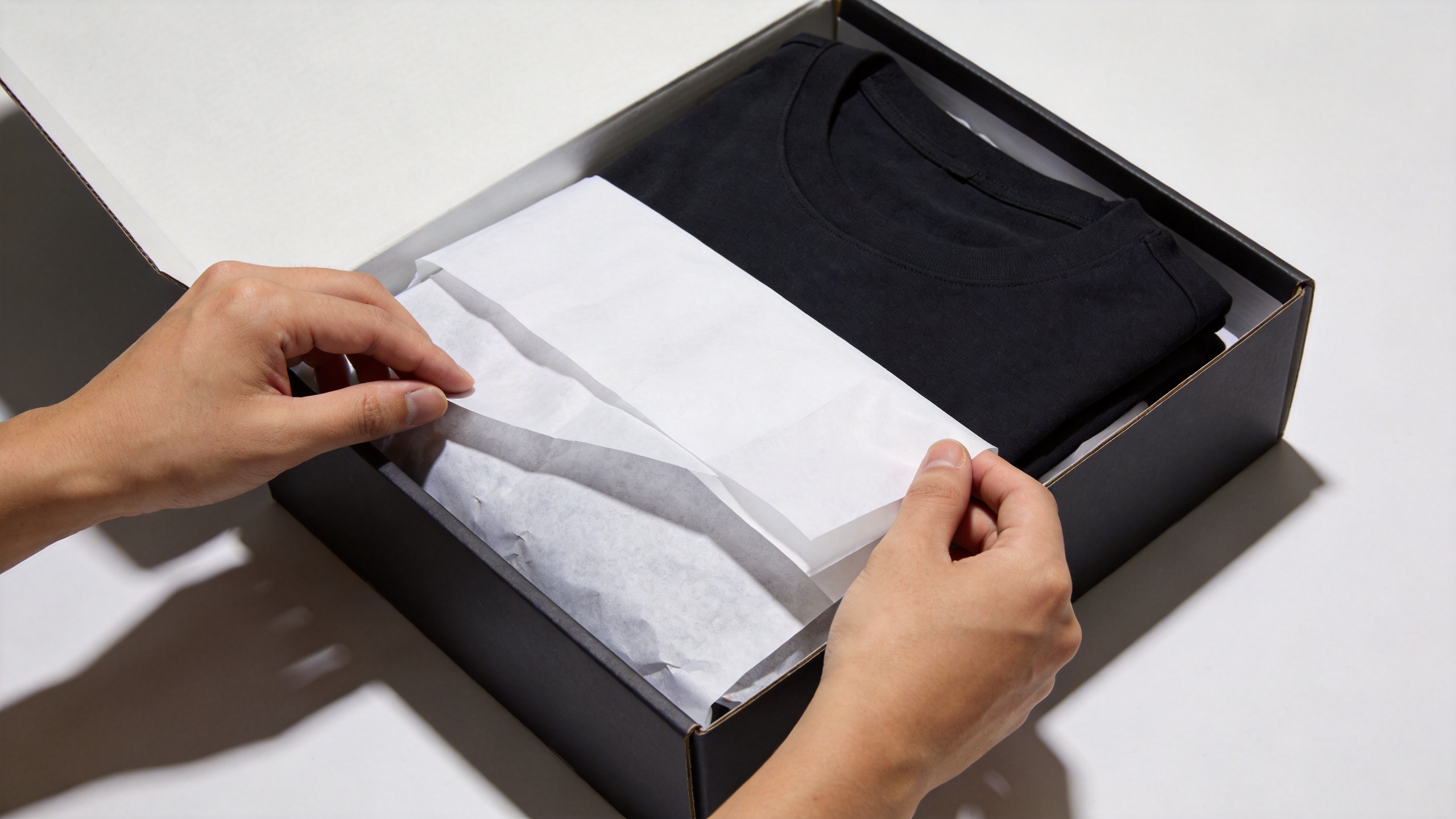
A clean sheet placed between folds keeps fabric panels from lying directly against one another. It can also separate a garment from a printed insert, a branded box interior, or adjacent items in a mixed order. This reduces the opportunities for rubbing contact during folding, stacking, and transit. The same approach can help preserve the visual finish of delicate garments, although tissue should not be presented as a substitute for all protective packaging.
For clothes wrapping paper, a consistent, clean surface is usually more useful than a decorative sheet that has not been evaluated around the actual garment. If the paper is printed or strongly colored, ask whether its own inks and colorants are suitable for the intended contact situation. Avoid assuming that a visual sample answers that question.
Wrapping tissue paper for clothes is especially helpful when the packer can place it deliberately: one sheet beneath a folded garment, one between high-contact folds where needed, and a final layer before the item enters the outer package. The goal is controlled separation, not unnecessary bulk.
Choose the tissue around the actual pack-out sequence
Begin with the handling sequence rather than a generic description of “premium” paper. Will the team fold knitwear, stack several dark pieces, wrap a screen-printed tee, or add a card and sticker? Will workers use pre-cut sheets or tear from a roll? Small choices influence whether the paper stays in place and whether the process is repeatable.
1. Check the garment surface first
Ask whether ink, dye, print, or embellishment has fully stabilized according to the garment supplier’s process. If there is uncertainty, packaging alone should not be expected to solve it. A small pack-out trial using representative garments is a more responsible next step than making a universal promise.
2. Check the tissue itself
For wrapping tissue paper for clothes, confirm the tissue color, finish, cleanliness, and whether there is printing on the side that will touch the garment. A light-colored, unprinted contact surface may make a simple screening trial easier to read. If brand printing is important, test the finished printed tissue rather than an unprinted substitute.
3. Check pressure and moisture conditions
A folded garment in a loosely packed gift box behaves differently from a compressed apparel shipment. Consider stacking height, packing pressure, warehouse humidity, and the time items will remain packed. The relevant question is not only paper thickness, but how the complete package behaves under the conditions it will meet.
A simple pre-shipment test is better than an assumption
A tabletop sample is useful, but the next question is whether it works during the intended pack-out sequence. Run a small trial with the real garment, tissue, inserts, closure method, and outer package. Include the highest-risk combination: dark colors, fresh printing, contrasting fabrics, and the maximum expected stack pressure.
- Fold a representative garment as the packing team normally would.
- Place the proposed wrapping tissue paper for clothes at each contact point.
- Add the actual inserts, labels, and outer pack.
- Apply realistic stacking or light pressure for an agreed observation period.
- Inspect both garment and tissue under normal work lighting before approving the routine.
For a higher-risk application, include both dry handling and the moisture conditions the product may realistically encounter. Document what was tested and what still needs confirmation. This guide helps frame the questions; it does not replace product-specific sample approval or a formal textile test where one is required.
Common mistakes that defeat the purpose
- Putting printed tissue directly against an uncertain garment surface. Decorative printing can be part of the experience, but the contact side and transfer risk need review.
- Using too little tissue in high-friction folds. One sheet may look adequate when laid flat but shift during packing and transit.
- Using tissue to hide a garment-quality issue. If the garment’s own color or print is unstable, address that upstream rather than relying on wrapping tissue paper for clothes as a guarantee.
- Approving only a flat visual sample. Test the fold, stack, insert, and closure together.
- Ignoring mixed-order handling. A process that works for one pale cotton shirt may need changes when dark, printed, textured, or embellished pieces share the station.
Where clothes wrapping paper fits in a brand-safe workflow
Clothes wrapping paper can support a polished presentation while giving operators a repeatable separation step. For retail and e-commerce teams, that can mean fewer uncontrolled surfaces touching the garment before the customer sees it. The most reliable approach is conditional: use tissue as one part of a complete pack-out specification, then validate the result with the products and conditions that matter to the order.
Putian C&Q Paper Co., Ltd. works with packaging, decorative, and filling paper applications. When discussing tissue for apparel, a clear request should distinguish the intended garment contact, sheet or roll format, desired color or print, order quantity, and the sample checks required before approval. That gives the supplier and packaging team a practical basis for reviewing fit without overstating performance.
Final checklist before choosing wrapping tissue paper for clothes
- What surface is the tissue meant to separate?
- Could the garment, printed tissue, label, or outer pack be the source of transfer?
- Which side of the tissue contacts the garment?
- Has the finished combination been tested in the actual fold and pack-out sequence?
- Have pressure, storage time, and humidity been considered?
- Is the selected format easy for the packing team to use consistently?
In short: wrapping tissue paper for clothes can reduce direct contact and make garment packing more controlled, but it is most useful when the tissue is chosen and tested as part of the whole workflow. Confirm the source of any transfer risk, trial the finished package, and then standardize the method that protects both the garment and the customer’s first impression.